Showing posts with label abuse. Show all posts

Wednesday, May 20, 2015

Are YOU a Bully (Part TWO)?

Bullying hurts.
It is NOT a joke.
It is NOT just kids being kids.
Bullying is cruel and leaves scars.
Bullying behavior is LEARNED behavior.
Bullies DON’T just appear out of the blue.
Bullying IS violence.


The following are quotes from actual bully victims (for reasons of privacy, only first names are used where available):

"I don't want to go to school anymore. They make my life hell. No-one listens. I want to end it all" --  Ray, age 14

"It's been a very hard experience. The boys are the bad people. I don't care about them, and they're going to get the punishment they deserve," -- Austin, a 16 year old autistic high school student who was duct taped to a football goal post, abandoned, and screamed for 22 minutes until help finally arrived.

"There were times when I'd just sit outside by myself at recess, just sit outside and pick at the grass, because I felt like the world hated me." -- Trish, now 31 years old, was bullied throughout her middle and high school years. Her abuse ranged from kids calling her "Tissue" and wiping their noses on her clothing, to her "best friend" punching her, to even her cousins and sister forming a club they called "W.H.E.A.T." — "We Hate Everything About Trish"

"It makes me feel bad and rather depressed. Like I don't want to be a part of this world any more." -- Anonymous, age 13, victim of cyber-bullying.

"I got messages from people telling me to kill myself and saying that the world would be better off without me and that everybody hated me. I was diagnosed with depression and anxiety. I lost all self esteem and became paranoid about people. I couldn't trust anyone because I found out that even some of the people who had been nice to me at a school had begun to send me abusive messages anonymously online,"  -- Natalie, age 15, whose bullying became so intense that she contemplated suicide.

"I was one of the odd ones out. The school did nothing." -- Sawyer, now 18, was punched in the back by a bully so hard that it brought him to his knees. Two days later, because of the pain, he was hospitalized; doctors informed him and his family that the punch likely caused the spinal blood clot which paralyzed him from the waist down.

"They make fun of my weight, and my clothes like they're pajamas. My class cut up my Tinkerbell shirt, now it has a big hole in it. I try to tell them to stop but they won't stop, they always push me down. It's really hard for me to take all that bullying. When they push me and make me sad and feel bad, it's really mean. I want to kill myself." -- Mariyah, age 7

I have included the quotes above, from the victims themselves in order to illustrate just how gravely serious the consequences of bullying can be. How severe does a behavior have to be that a 7 year old child thinks about taking their own life?

Part One of this series asked the hard question: "Are YOU a bully?"

I think it is important, before continuing, to read and then re-read the words of the victims. Because what a bully sees as "fun" can have devastating effects.

In light of the words of the victims, another sobering question must be asked: "Do you want to be the cause of someone's death?"

Bullying can kill, and has. Victims of bullying are 2-9 times more likely to consider suicide than non-victims, according to studies by Yale University. A study in Britain found that at least 50% of suicides among young people were related to bullying. The same study determined that 10 to 14 year old girls may be at even higher risk for suicide. According to statistics reported by ABC News, nearly 30 percent of students are either bullies or victims of bullying, and 160,000 kids stay home from school every day because of fear of bullying. Bully-related suicide -- which is so prevalent that it has been termed "bullycide" -- can be connected to any type of bullying, including physical bullying, emotional bullying, cyber-bullying, and sexting.

In “Are YOU a Bully (Part ONE)”, we explained that bullies may see their behavior as a way of being popular, or making themselves look tough and in charge.

As a refresher, here are a few more questions to consider in determining if you have ever behaved in a bullying manner.

Have you ever repeatedly:

  • Called someone names?
  • Physically hurt someone on purpose (hitting, kicking, punching etc)?
  • Used your size to intimidate or threaten others?
  • Made fun of people you perceive as different?
  • Made fun of a person’s culture or religion?
  • Laughed at someone because they have a disability?
  • Said nasty things about another person’s weight, hair color, skin color or clothes?
  • Taken someone else’s belongings?
  • Damaged or destroyed someone else’s property?
  • Spread rumors about someone?
  • Said nasty things about someone behind their back?
  • Purposely not invited someone to go out with you and your friends?
  • Excluded someone from your group on purpose?
  • Made someone cry on purpose?
  • Sent someone nasty or threatening emails or texts?
  • Posted mean or unkind comments about another person on a social networking site (Instagram, SnapChat, Twitter, Facebook, etc)?
  • Laughed at someone who is being picked on?
  • Are you jealous of the person you are bullying?
  • Worried about something that may be happening in your own life?
  • Being mistreated by someone in your life?
  • Are you hanging around with other bullies and want to fit in?
  • Do you like the feeling of power bullying gives you?
  • Do you think bullying someone makes you popular?
  • Are you being bullied yourself and taking it out on someone else?
  • Have you ever bullied someone, then denied it to a parent, teacher or authority figure? Even if they may have seen you do it?
  • Have you ever threatened to harm someone if they reported your behavior? 
If you answered “Yes” to any of the above questions, then, by definition you have engaged in bullying behavior, and you need to think about why you do these things.

In class, we have discussed various possible reasons for bullying behavior.

They are:

  • Some bullies seek attention ... even negative attention means someone is noticing them
  • To steal things from others
  • To make others afraid of them ... this gives a sense of power
  • Some are jealous of the person they are bullying
  • Many bullies may even be being bullied themselves
  • Many bullies have had a bad experience themselves or they feel unhappy and/or insecure with their lives.
  • Some bullies live abusive home lives
  • And a few bullies may not even understand how wrong their behavior is and how it makes the sufferer feel. 
Of course, none of these things excuses a bully’s behavior. Understanding the underlying cause, however, can sometimes help in solving the situation.

Bullying can be likened to addiction; bullies become addicted to the power and control they have over others. That desire for power and control not only leads to negative attention, but may lead to much bigger trouble later in life. Research has shown that by the age of 24, bullies are 60% more likely to have a criminal record than any other group (Andy Tomko, You Big Bully, 2005). I don't know of anyone who willingly seeks out this type of life for themselves.

There is always hope for those who are willing to seek help. Those who recognize the error of their ways and are willing to make the effort to change and become better deserve respect, support, and encouragement.

As with any problem, admitting it is the first step. Own your behavior. Admit to yourself that what you are doing to others is wrong. Accept responsibility and reach out to someone and ask for assistance. Talk to your parents ... a teacher ... your Martial Arts instructor ... a school counselor. Talking about what you are doing brings it into the light; it may help you understand why you are doing it and provide an opportunity to change.

If bullying has become habitual -- that is, you have engaged in it for a considerable length of time -- it may not be easy to just stop. However, be patient and keep reminding yourself that you are doing the right thing and it will not only make a huge difference in your life but in the lives of those you once bullied.

If you have engaged in bullying behavior, regardless of the reason, you need to reach out for help. AND, YES, YOU CAN CHANGE.

Here are a few things that you may find helpful in changing your behavior:

  • Talk to someone -- a parent, guardian, teacher, etc. -- and tell them how you feel; be completely honest
  • Apologize to the person(s) you have been bullying. Out of anger or fear, they may not immediately accept your apology, and that is OK. It is your effort that is important, as long as it is sincere and you truly mean it. 
  • Stop hanging around with other bullies ... even if you think of them as "friends" being around them is not healthy, and it will be too easy for you to be drawn back into negative behavior.
  • Join a local youth club or sports team ... not only is the physical effort a good, healthy outlet for any pent up aggression, but sports teach teamwork and how to productively interact with peers
  • Make new friends ... if you are cutting out the negative people in your life, seek out positive influences.
  • Set goals, such as being friendly to everyone you meet or not being nasty or hurting anyone; if bullying is a habit, so is kindness and compassion. The more you exercise those healthy qualities, the stronger and more natural they will become.
  • Talk to your friends -- your real friends -- and ask them to help you stop
  • Do some volunteer work -- read to someone in a nursing home; pick up trash in the neighborhood; help out in the school counseling office; give talks about how not to be a bully. These are great ways to practice kindness, compassion, respect and to build a better self-image. 

    In conclusion, having read the words of the victims, and understanding the fear and pain with which they live  ... having asked yourself the difficult questions ... and realizing that bullying behavior may end lives, there is still hope.

    Even if you are a bully, y
    ou Can change ... and Barnes Martial Arts is here to help.

Monday, March 23, 2015

Cards & Letters for Blake Kitchen

This is a copy of an article I submitted to the local news media. I felt that our Studio did a good thing for Blake Kitchen; it came from the heart. We didn't do it to seek publicity. But after much consideration, I wrote this article for two reasons: (1) I am proud of each and every student who took valuable time away from their own lives to encourage and support a boy whom none of us know personally, but who just as easily could have been one of us. You are the future of Martial Arts ... not just in Northeast, PA but anywhere you go. It is nice knowing that the future will be one of  not just fighting skills but compassion, respect and community involvement; and (2) to highlight the tragedy of bullying. As I said in the article, bullying is an epidemic in this country; it affects millions of people of all ages, races, economic backgrounds and from all walks of life. Having experienced bullying in my youth, that breaks my heart.

Thank you for reading and, of course, please feel free to respond with your thoughts and comments. -- Master Gary R. Barnes
FORTY FORT MARTIAL ARTS STUDIO ORGANIZES CARD AND LETTER CAMPAIGN FOR BULLYING VICTIM

(FORTY FORT) 
What was it about an incident of bullying that occurred 900 miles away in Liberty, Missouri that motivated a Martial Arts instructor from NEPA to mobilize his students and their families to write cards and letters in support of the victim?

When I was young I was bullied, too, mercilessly. I have students who were bullied. I personally know victims of bullying. So when I read Blake’s story on March 7, my heart went out to him,” says Master Gary R. Barnes, owner of Barnes Martial Arts in Forty Fort. “Like Blake, other victims of bullying – myself and some of my students included – know all too well what it is like to live in fear and to have those fears ignored by school administrators, who should know better. His experience deeply moved me.”


Blake Kitchen is a 12 year old sixth grader with Asperger’s Syndrome (a form of autism) at Liberty Middle School who was severely beaten by a school bully. The incident occurred when Blake arrived at school for breakfast. He took his usual spot in the cafeteria when another boy – an 8th grader who at 200 pounds outweighed Blake by nearly 125 pounds – moved his belongings and took his seat. When Blake asked him to move, the other boy responded violently. The beating was so bad that it left him with a broken jaw, fractured skull, cuts and contusions and cerebrospinal fluid leaking from his ear. At one point the bully smashed his head off the cafeteria table until he passed out. Blake spent five days in the hospital and may require further surgery to repair damage to his ear.

Bullying is an epidemic in this country,” says Barnes. “And like rape, it often goes under-reported.

Because of the level of violence and lack of participation by school officials, Blake’s story is one that received national attention. Unfortunately, though, it is not atypical. The Bully Project, estimates that this year alone over 13 million American kids will be bullied at school, at home, on the bus and on their phones and computers. 3 million students are absent each month because they feel unsafe at school, and 1 in 4 teachers sees nothing wrong with bullying – taking the attitude that it is simply ‘kids being kids’, only intervening 4% of the time.

What happened to Blake Kitchen could just as easily have happened here in Northeast PA,” Barnes cautions. “In fact, it has on a number of occasions. Blake Kitchen is us, is our children – I had to reach out to him and let him know that he isn’t alone.


To that end, Barnes imparted the story and information to his students and their families, encouraging them to make and write cards and letters of encouragement. Barnes Martial Arts students and their families rallied to the cause by the dozens, contributing letters and cards signed by multiple students across different classes. Barnes broadcast the message on Facebook, by email and even going so far as to post online to the group page of the Random Acts of Kindness Foundation, of which he and the Studio are members. This resulted in even more cards and letters being sent from all over the United States and as far away as England and Australia.


     “If by doing this we can bring a 12 year old boy a small ray of hope and peace, and perhaps shine a light on the epic problem of bullying, then I’d say we have done a good thing.
 Barnes says, “Bullying, in a very real sense, is what initially brought me to the Martial Arts, and bully prevention has been one of the driving focuses of my Studio. In order to do our part, we have either partnered with or utilize material developed by several leading experts in the field – Dave Kovar of Martial Artists Against Bullying and his groundbreaking Done with Bullying program; Tom Callos of the 100method; The Bully Project, among several others. We are very serious about confronting this issue, and while we could not prevent what happened to Blake, by writing to him we can let him know that the whole world isn’t like the person who victimized him.

Every month the Studio engages in a Kindness Mission, a group project designed to balance the physical techniques, the self-defense aspects of the Martial Arts with compassion, respect, and community outreach. Because of the experiences that have informed my life’s work, this card and letter campaign is one of the most personal for me,” Barnes continued. “More importantly, though, our students – everyone from four year olds to adults – saw the value and really stepped up. We have a truly amazing group of people here. Entire families got involved. A space was created to open up a dialogue on the nature of bullying and its far-reaching effects. Our school motto is ‘Out of the Dojo, Into the World’ and the students really rose to that. I couldn’t be prouder; they are making a quite difference in their communities and schools."


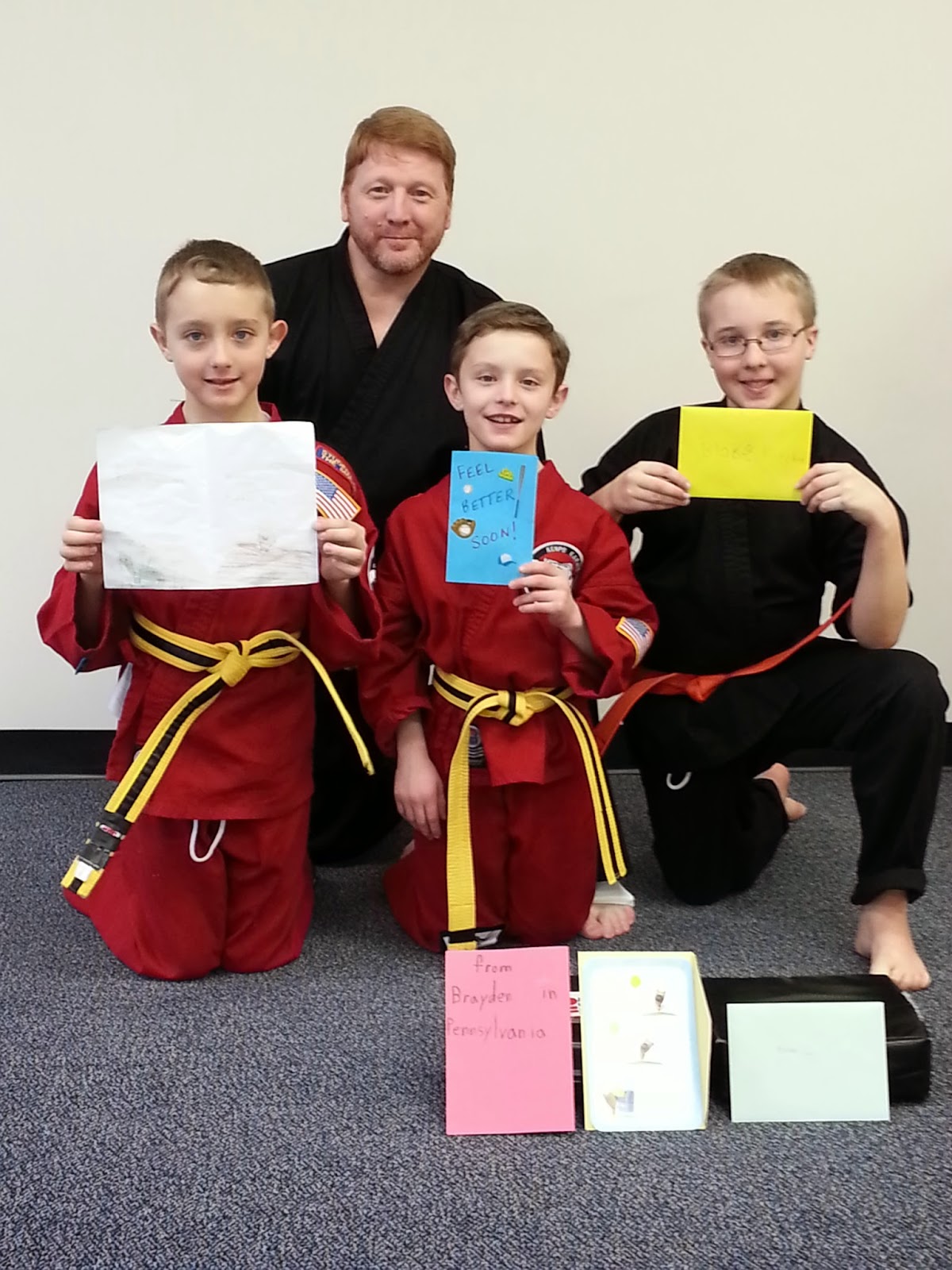
(A few of Barnes Martial Arts Little Dragons (ages 4-7) and their Cards for bullying victim Blake Kitchen. From left to right: Evan Harchar, Brayden Isaacs, Noah Gray. Missing from photo: McKena Harlen)


(Barnes Martial Arts Students Emma Lewis (l) and Barbara Lewis (r) and the cards they made for Blake Kitchen)
(Barnes Martial Arts Junior Students and the cards they made for bullying victim, Blake Kitchen. Kneeling, left to right: Michael Bonk, Jakr Ranieli, Ethan Edwards. Back row: Master Gary R. Barnes. Missing from photo: Sarah Feifer)

Saturday, October 25, 2014

The Cold, Hard Facts About Domestic Violence.

In light of both October being National Domestic Violence Awareness Month, and our Domestic Violence Education and Awareness Seminar scheduled for Saturday, October 25 from 2-4pm, we thought it might be eye-opening to share some of the facts and statistics behind this woefully under-reported crime.

The following statistics were culled from publicly available published reports from various sources, including the Federal Bureau of Investigation (FBI), U.S. Department of Justice (USDoJ), the Centers for Disease Control and Prevention (CDC), the Institute for Children and Poverty, National Coalition Against Domestic Violence, and National Criminal Justice Reference Center among others. 


Domestic violence (also known as intimate partner violence) can happen to anyone, regardless of gender, race, ethnicity, sexual orientation, income, or other factors.

The Victims

  • 1 in 4 women will experience domestic violence during her lifetime.
  • Women experience more than 4 million physical assaults and rapes committed by their partners, while men are victims of nearly 3 million physical assaults.
  • Women are more likely than men to be killed by an intimate partner
  • Women ages 20 to 24 are at greatest risk of becoming victims of domestic violence.
  • Every year, 1 in 3 women who is a victim of homicide is murdered by her current or former partner.

The Families

  • Every year, more than 3 million children witness domestic violence in their homes.
  • Children who live in homes where there is domestic violence also suffer abuse or neglect at high rates (30% to 60%).
  • A 2005 Michigan study found that children exposed to domestic violence at home are more likely to have health problems, including becoming sick more often, having frequent headaches or stomachaches, and being more tired and lethargic.
  • A 2003 study found that children are more likely to intervene when they witness severe violence against a parent – which can place a child at great risk for injury or even death.

The Circumstances

  • Domestic violence is most likely to occur between 6 pm and 6 am.
  • More than 60% of domestic violence incidents happen at home.

The Consequences

  • According to the U.S. Department of Housing and Urban Development (HUD), domestic violence is the third leading cause of homelessness among families.
  • In New York City, 25% of homeless heads of household became homeless due to domestic violence.
  • Survivors of domestic violence face high rates of depression, sleep disturbances, anxiety, flashbacks, and other emotional distress -- all indications of Post-traumatic Stress Disorder (PTSD).
  • Domestic violence contributes to poor health for many survivors.  For example, chronic conditions like heart disease or gastrointestinal disorders can become more serious due to domestic violence. 
  • Among women brought to emergency rooms due to domestic violence, most were socially isolated and had fewer social and financial resources than other women not injured because of domestic violence.
  • Without help, girls who witness domestic violence are more vulnerable to abuse as teens and adults.
  • Without help, boys who witness domestic violence are far more likely to become abusers of their partners and/or children as adults, thus continuing the cycle of violence in the next generation.
  • Domestic violence costs more than $37 billion a year in law enforcement involvement, legal work, medical and mental health treatment, and lost productivity at companies.
#1 FACT: Most domestic violence incidents are never reported.

By speaking up, speaking out, shining a light on the issue, breaking the silence, and joining forces with the Domestic Violence Service Center (DVSC), Barnes Martial Arts is striving to make a difference and change those facts for local victims of domestic violence. 

For more information on Domestic Violence and what you can do to help please contact Louise at DVSC (570)-823-6799 ext .238 or visit https://www.domesticviolenceservice.org/


The information in this blog article appeared in a previous, slightly differently edited form at SafeHorizon. 

Thursday, April 3, 2014

It Isn't Just the Kids ... The Bully at the Blackboard

I believe that the majority of teachers are dedicated, considerate, sympathetic individuals. 

As student to teacher ratios increase, faced with a wide variety of student personalities, and often fighting an entrenched bureaucracy that is frequently more concerned about money than people, their job can be thankless.

I have good friends who are/were public school teachers; they are on the whole decent, caring people. After speaking with them about situations they have encountered I completely understand how they 
can be under a tremendous amount of stress.

However, I have also personally had several experiences with teachers who were ... less than pleasant. One, a gym teacher, stood by and observed as I was beat up by another student; another,
an Algebra teacher, openly and repeatedly ridiculed me in front of the class (and, as you have learned in class, two of the requirements for bullying are that an action or behavior be repeated and have bad intentions). Perhaps I will cover those specific incidents in greater depth in another article, but those experiences opened my eyes to the fact that even people in whom we -- and our children -- routinely place our trust can be bullies, and be abusive.

Physical bullying is fairly easy to spot -- black eyes, bumps and bruises. Emotional and psychological abuse -- repeated name calling, insults, character assassination, even sexual harassment -- on the other hand, can be far more subtle. Too many children are already silent about being bullied by their peers; when such treatment comes from an authority figure, the matter may be seen as totally "undiscussable". 


Our kids spend a minimum of 8 hours a day out of our sight when they are at school. We need to know they are safe.

I have provided several links to articles about incidents where teachers abused their authority. The articles also contain tips and suggestions about what can be done if such behavior occurs. 


The bottom line, in my opinion, though ... is that we need to keep open lines of communication with our children. Talk to them.

Barnes Martial Arts mission is to eradicate bullying behavior in ALL of its ugly forms. 


http://www.greatschools.org/parenting/bullying/5063-when-the-teacher-is-the-bully.gs?page=all

http://bullying.about.com/od/Victims/a/10-Ways-To-Respond-To-A-Teacher-Who-Bullies.htm

http://shine.yahoo.com/parenting/tween-catches-bully-teacher-on-tape-234052398.html

http://www.webmd.com/parenting/features/teachers-who-bully?page=3

Friday, March 7, 2014

More Than One Victim When It Comes to Bullies ...

Bullies affect ALL of us. 
The tragic story of Jeremiah Lasater is one that hammers home the reason why so much of our class discussion focuses on dealing with bullies. This is the first in an ongoing number of articles that will deal with this important, powerful subject. 

I know from personal experience that no one is immune to such treatment. It can happen to anyone and for any reason. We here in NEPA, are not immune; as recent stories on the evening news will attest, bullying happens all too frequently.

One of our goals is to instill an inner strength in our kids that discourages bullies. This, combined with education of the nature and effect of bullies and bullying, is but one step in dealing with, and hopefully eradicating, this epidemic.

Additionally, it is our duty as Martial Artists to step-up and help defend those who cannot, for whatever reason, defend themselves. That doesn’t necessarily mean fighting; but being a friend, a good listener, a helping hand.

http://www.npr.org/2014/01/31/268996343/when-jeremiah-couldnt-take-more-bullying-he-took-his-life