Showing posts with label non-violence. Show all posts

Saturday, January 23, 2016

How to Find Stillness in Meditation ... and in Life

As we prepare to begin weekly meditation sessions at the Studio, I thought it best to examine the reasons and benefits of maintaining a regular meditative practice. 

Many of us struggle to sit still -- not just in meditation, but all of the time; we find it nearly impossible to turn ourselves “off”. Like a live wire humming with electricity we seem to feel we must always be doing something.

Impatience and restlessness consume us. 
Tension throbs in our heads. 
Nervous tics manifest in our gestures. 

Presenting as depression, anxiety and cardiac issues, stress is literally killing us. Even when our bodies stop moving – when we are watching TV, or reading a book, for instance – our minds spend so much time racing from one errant thought to the next that we find it difficult, if not impossible, to focus on the very things we do to relax. 

No matter where we are or what we are doing, we feel embroiled in chaos. 

In the car – we want to get where we are going and get there now; consequently, the cars in front of us are never driving fast enough; there is always some delay – construction detours, extra long red-lights ... it all conspires against us. The resultant emotion can manifest as anything from mild annoyance -- "How dare they inconvenience me!" -- to full-blown road rage.

Waiting in line at the store – of course, the person in front of us not only has two carts full of groceries and, of course, they are paying by check, but wait just a moment while I find my pen, I know it’s in here somewhere. 

At work or in school 
 – we have a thousand things to do, reports are due, deadlines must be met, there are meetings to attend, work piles up, parent-teacher conferences that cannot be missed, there isn’t enough time in the day, and yet the clock drags. 

At home – we have yard work, laundry, house cleaning, meals to be prepared, school lunches to be packed, kids have to go to piano lessons, sports, and doctor’s appointments. We cook our meals in minutes in the microwave or order takeout from the drive through since we don’t have time to sit down to a proper, healthy meal. Our foot taps incessantly while we wait for web pages to load, cursing under our breath if they take more than a few seconds.  

Suddenly it’s like everything has to happen right now and you cannot sit still until it’s done.

And it’s not just you, is it? 

Look around. The world itself is in a rush, people hustling and bustling, constantly moving, hurrying to get somewhere, -- anywhere! -- other than where they are! 

It seems everyone is losing their collective cool a little too quickly these days. Tempers flare at the slightest provocation. We hurl insults and names at one another. We grit our teeth and find ourselves just one misspoken word away from a physical altercation ... as if that would deescalate the tension.

Why? 


Maybe it’s our culture of instant gratification. Maybe it is the advent of technology that is supposed to provide convenience and make our lives more efficient. Maybe it is advertising that sells us on the idea that we constantly have to have more, that happiness comes from things we can buy: if we only buy this program, take that pill, wear these shoes, drive this car, live in this neighborhood, we will be better than the other guy. 

Or maybe ... just maybe ... it is something deeper, something compounded by all of those things. 

Maybe we have lost touch with a fundamental part of ourselves, a connection with the greater world around us, the rhythm of nature. At our very core is a part that recognizes the need to slow down, be patient, and live in the present moment.

Through meditation, I have learned that stillness is not just an external posture. There is a deeper internal, and, yes, spiritual dimension to stillness. 

Allow me to present these 4 simple tips for how to be still when you meditate.

4 SIMPLE STEPS --

(1) DON’T MOVE

This seems obvious, but you’d be surprised -- or maybe not -- by how hard this can be. You must commit to not moving at all. Don’t just plop down somewhere and try to be still. Rather, make a commitment to yourself that you are going to do this and then persevere.

Your focused intention will make a huge difference.

Like anything new, it will take practice. Unless you already train in Martial Arts or yoga, it may not come naturally. In the beginning, you will almost certainly think of a million things that need to get done, even more that cannot be done without you. Your mind will flit restlessly from thought to thought to thought; you will fidget on your cushion or in your chair. When I first started, I managed to sit still for maybe 30 seconds before I knew I had to get up, before my muscles would start twitching with kinetic energy. I willed myself to remain in place, though, and after a few sessions the feeling began to diminish. Soon, I was sitting for 20 minutes, then 30, then an hour. The longest session I ever did was almost six hours, split into two 3-hour sessions with a slight break in between. So progress is not only possible, it is inevitable

With practice and patience -- a lot of patience -- you will master this. 

(2) START SIMPLE

It’s important to build your confidence in being still. You don’t need to follow a complex ritual, recite intricate mantras, or deck yourself out in robes (unless you want to ... then, by all means go for it!).

Find a comfortable spot, sit down, close your eyes and breathe. It really doesn’t need to be any more complicated than that.

Depending on your level of practice, sit still for an appropriate amount of time.

For example, if you are a novice, try sitting perfectly still for 1 minute. If it goes well, increase it to 2 minutes. Then try 5 minutes, etc.

As I said above, I started with 30 seconds. I would sit quietly in my chair, legs crossed and hands laid loosely upon my knees in half-lotus position (not a necessity, by the way), and I would follow my breath. If a thought arose – and a ton of them did – I would notice it, and then return my attention to my breath. The more I practiced, the easier it became to focus solely on my breath and to quiet my mind.

You too can find your comfort threshold and practice right at the edge, slowly increasing your capacity for stillness.

(3) PAY ATTENTION

When you are sitting still, notice what’s happening. Notice the thoughts rising like bubbles but do not attach to them. How does being still affect the quality of your awareness? Don’t devote a lengthy amount of time to thinking about it, just observe.

When you are able to sit still for long periods of time, you will start to notice the profound relationship between outer and inner stillness. The inner stillness that you are cultivating will carry over into your daily life; you will be calmer, more relaxed, more aware of your surroundings, more acclimated to the present moment, less prone to anger.

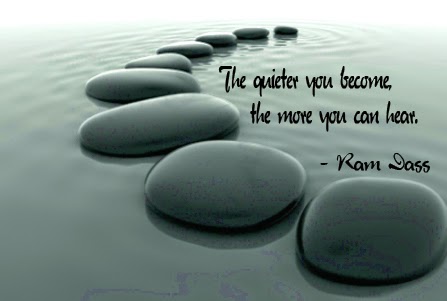
The stiller you become, the deeper your capacity for meditation; but more importantly, the stiller you become, the more peaceful and aware you become.

The stillness becomes an oasis in the midst of a busy day; the calm center to which you retreat when life becomes hectic or overwhelming. In such times, you tap into the reserves you have built up.

And meditation becomes a state of being rather than something you do.
 
(4) RELAX

It’s easy to experience tension when trying to be still. I read once that meditation is the perfect middle place between being alert and relaxed; the experience of that middle place is deep inner stillness.

There is no tension in that stillness. You are alert and deeply relaxed.

In order to achieve relaxation, you must breathe. Many schools of meditation tell you to breathe normally as you meditate. I have found, on the other hand, that deep breathing, from the abdomen – the center – helps to promote a relaxed body and a calm, peaceful mind.

Try this: after you are seated comfortably, take a few – say, four or five -- deep, cleansing breaths; breathe in slowly for a count of four,until your lungs are full (but not over full to the point of discomfort), hold it for another count of four, then exhale very slowly four a count of four until your lungs are empty. You can do this as a “cleansing ritual” prior to your actual meditation, or as the focus of the meditation itself.  

As you learn how to be still in meditation, it is important to remember to relax at all times. Meditation is the opposite of tension. It’s all about release and freedom.

To experience the many benefits of meditation, I invite you to join us at the Studio, Saturday mornings at 10:30, beginning February 6th, 2016.

Sit with us.
Breathe with us.
Become still and centered. 


For more information, please call us at (570) 332-4377 or email us at barnesmartialarts@yahoo.com

Monday, July 13, 2015

BARBARA LEWIS -- June 2015 Student of the Month

On Wednesday, July 8 Barbara Lewis was chosen as Student of the Month for June 2015. 

Barbara, age 49, has been a member of the Adult Program since coming to the Studio following a self-defense seminar held at McCann School of Business and Technology in Wilkes-Barre. Barbara enrolled her daughter at the Studio after the seminar. Her own involvement came when she was challenged by her daughter, Emma.

“Emma told me, if I can do this so can you,” says Barbara.


In addition to Martial Arts, Barbara, a resident of Plains, PA lists reading and meditation as other interests.

According to Master Barnes, “Barbara was chosen as Student of the Month for a number of reasons: her enthusiasm for self-defense, which is her favorite part of class; her positive attitude; her willingness to accept and overcome challenges; her participation in every community event and monthly Kindness Mission; she is very tenacious when it comes to learning new techniques and concepts, never settling until she completely understands. Perhaps the most significant reason, though, is the massive personal transformation she experienced as a result of her training. When Barb first came to us, she was very quiet, almost shy, and not very engaged in the class; as time passed, however, and she became aware of her own inner strength, her confidence grew and she really came out of her shell. So much so, that the other students now refer to her as The Barbinator!”

Students of the Month are chosen based on a variety of criteria, including: class participation, discipline, attitude, technique, personal conduct and how well they exemplify the Martial Arts in ALL areas of their lives, in and out of the studio.


When asked if she had any advice for others who might be considering Martial Arts training, Barbara responded, “Don’t just think about doing something; do it. Just because you think you can’t do something today, doesn’t mean you won’t be able to do it tomorrow. Don’t compare yourself to others. Always strive to make your tomorrow better than your best today.”

Great advice, Barb!! Congratulations!!

Wednesday, May 20, 2015

Are YOU a Bully (Part TWO)?

Bullying hurts.
It is NOT a joke.
It is NOT just kids being kids.
Bullying is cruel and leaves scars.
Bullying behavior is LEARNED behavior.
Bullies DON’T just appear out of the blue.
Bullying IS violence.


The following are quotes from actual bully victims (for reasons of privacy, only first names are used where available):

"I don't want to go to school anymore. They make my life hell. No-one listens. I want to end it all" --  Ray, age 14

"It's been a very hard experience. The boys are the bad people. I don't care about them, and they're going to get the punishment they deserve," -- Austin, a 16 year old autistic high school student who was duct taped to a football goal post, abandoned, and screamed for 22 minutes until help finally arrived.

"There were times when I'd just sit outside by myself at recess, just sit outside and pick at the grass, because I felt like the world hated me." -- Trish, now 31 years old, was bullied throughout her middle and high school years. Her abuse ranged from kids calling her "Tissue" and wiping their noses on her clothing, to her "best friend" punching her, to even her cousins and sister forming a club they called "W.H.E.A.T." — "We Hate Everything About Trish"

"It makes me feel bad and rather depressed. Like I don't want to be a part of this world any more." -- Anonymous, age 13, victim of cyber-bullying.

"I got messages from people telling me to kill myself and saying that the world would be better off without me and that everybody hated me. I was diagnosed with depression and anxiety. I lost all self esteem and became paranoid about people. I couldn't trust anyone because I found out that even some of the people who had been nice to me at a school had begun to send me abusive messages anonymously online,"  -- Natalie, age 15, whose bullying became so intense that she contemplated suicide.

"I was one of the odd ones out. The school did nothing." -- Sawyer, now 18, was punched in the back by a bully so hard that it brought him to his knees. Two days later, because of the pain, he was hospitalized; doctors informed him and his family that the punch likely caused the spinal blood clot which paralyzed him from the waist down.

"They make fun of my weight, and my clothes like they're pajamas. My class cut up my Tinkerbell shirt, now it has a big hole in it. I try to tell them to stop but they won't stop, they always push me down. It's really hard for me to take all that bullying. When they push me and make me sad and feel bad, it's really mean. I want to kill myself." -- Mariyah, age 7

I have included the quotes above, from the victims themselves in order to illustrate just how gravely serious the consequences of bullying can be. How severe does a behavior have to be that a 7 year old child thinks about taking their own life?

Part One of this series asked the hard question: "Are YOU a bully?"

I think it is important, before continuing, to read and then re-read the words of the victims. Because what a bully sees as "fun" can have devastating effects.

In light of the words of the victims, another sobering question must be asked: "Do you want to be the cause of someone's death?"

Bullying can kill, and has. Victims of bullying are 2-9 times more likely to consider suicide than non-victims, according to studies by Yale University. A study in Britain found that at least 50% of suicides among young people were related to bullying. The same study determined that 10 to 14 year old girls may be at even higher risk for suicide. According to statistics reported by ABC News, nearly 30 percent of students are either bullies or victims of bullying, and 160,000 kids stay home from school every day because of fear of bullying. Bully-related suicide -- which is so prevalent that it has been termed "bullycide" -- can be connected to any type of bullying, including physical bullying, emotional bullying, cyber-bullying, and sexting.

In “Are YOU a Bully (Part ONE)”, we explained that bullies may see their behavior as a way of being popular, or making themselves look tough and in charge.

As a refresher, here are a few more questions to consider in determining if you have ever behaved in a bullying manner.

Have you ever repeatedly:

  • Called someone names?
  • Physically hurt someone on purpose (hitting, kicking, punching etc)?
  • Used your size to intimidate or threaten others?
  • Made fun of people you perceive as different?
  • Made fun of a person’s culture or religion?
  • Laughed at someone because they have a disability?
  • Said nasty things about another person’s weight, hair color, skin color or clothes?
  • Taken someone else’s belongings?
  • Damaged or destroyed someone else’s property?
  • Spread rumors about someone?
  • Said nasty things about someone behind their back?
  • Purposely not invited someone to go out with you and your friends?
  • Excluded someone from your group on purpose?
  • Made someone cry on purpose?
  • Sent someone nasty or threatening emails or texts?
  • Posted mean or unkind comments about another person on a social networking site (Instagram, SnapChat, Twitter, Facebook, etc)?
  • Laughed at someone who is being picked on?
  • Are you jealous of the person you are bullying?
  • Worried about something that may be happening in your own life?
  • Being mistreated by someone in your life?
  • Are you hanging around with other bullies and want to fit in?
  • Do you like the feeling of power bullying gives you?
  • Do you think bullying someone makes you popular?
  • Are you being bullied yourself and taking it out on someone else?
  • Have you ever bullied someone, then denied it to a parent, teacher or authority figure? Even if they may have seen you do it?
  • Have you ever threatened to harm someone if they reported your behavior? 
If you answered “Yes” to any of the above questions, then, by definition you have engaged in bullying behavior, and you need to think about why you do these things.

In class, we have discussed various possible reasons for bullying behavior.

They are:

  • Some bullies seek attention ... even negative attention means someone is noticing them
  • To steal things from others
  • To make others afraid of them ... this gives a sense of power
  • Some are jealous of the person they are bullying
  • Many bullies may even be being bullied themselves
  • Many bullies have had a bad experience themselves or they feel unhappy and/or insecure with their lives.
  • Some bullies live abusive home lives
  • And a few bullies may not even understand how wrong their behavior is and how it makes the sufferer feel. 
Of course, none of these things excuses a bully’s behavior. Understanding the underlying cause, however, can sometimes help in solving the situation.

Bullying can be likened to addiction; bullies become addicted to the power and control they have over others. That desire for power and control not only leads to negative attention, but may lead to much bigger trouble later in life. Research has shown that by the age of 24, bullies are 60% more likely to have a criminal record than any other group (Andy Tomko, You Big Bully, 2005). I don't know of anyone who willingly seeks out this type of life for themselves.

There is always hope for those who are willing to seek help. Those who recognize the error of their ways and are willing to make the effort to change and become better deserve respect, support, and encouragement.

As with any problem, admitting it is the first step. Own your behavior. Admit to yourself that what you are doing to others is wrong. Accept responsibility and reach out to someone and ask for assistance. Talk to your parents ... a teacher ... your Martial Arts instructor ... a school counselor. Talking about what you are doing brings it into the light; it may help you understand why you are doing it and provide an opportunity to change.

If bullying has become habitual -- that is, you have engaged in it for a considerable length of time -- it may not be easy to just stop. However, be patient and keep reminding yourself that you are doing the right thing and it will not only make a huge difference in your life but in the lives of those you once bullied.

If you have engaged in bullying behavior, regardless of the reason, you need to reach out for help. AND, YES, YOU CAN CHANGE.

Here are a few things that you may find helpful in changing your behavior:

  • Talk to someone -- a parent, guardian, teacher, etc. -- and tell them how you feel; be completely honest
  • Apologize to the person(s) you have been bullying. Out of anger or fear, they may not immediately accept your apology, and that is OK. It is your effort that is important, as long as it is sincere and you truly mean it. 
  • Stop hanging around with other bullies ... even if you think of them as "friends" being around them is not healthy, and it will be too easy for you to be drawn back into negative behavior.
  • Join a local youth club or sports team ... not only is the physical effort a good, healthy outlet for any pent up aggression, but sports teach teamwork and how to productively interact with peers
  • Make new friends ... if you are cutting out the negative people in your life, seek out positive influences.
  • Set goals, such as being friendly to everyone you meet or not being nasty or hurting anyone; if bullying is a habit, so is kindness and compassion. The more you exercise those healthy qualities, the stronger and more natural they will become.
  • Talk to your friends -- your real friends -- and ask them to help you stop
  • Do some volunteer work -- read to someone in a nursing home; pick up trash in the neighborhood; help out in the school counseling office; give talks about how not to be a bully. These are great ways to practice kindness, compassion, respect and to build a better self-image. 

    In conclusion, having read the words of the victims, and understanding the fear and pain with which they live  ... having asked yourself the difficult questions ... and realizing that bullying behavior may end lives, there is still hope.

    Even if you are a bully, y
    ou Can change ... and Barnes Martial Arts is here to help.

Saturday, July 12, 2014

Finding Stillness, Part 2


Finding Stillness, Part 2

The Chinese symbols to the left may be translated as quiet, peaceful, calm, stillness, comfort. 

As we discover the stillness within, we recognize the calming effect it has on our mind, body and spirit.

But stillness may have a calming effect on the world around us as well. By becoming still, we may cause others to pause, to pay attention; our quiet also quiets others. We set the mood for those who work and train and interact with us.

We lead by example. 

When we rush and set a hectic pace – at work, in school, at home, on the mat in Martial Arts class -- others become stressed in an effort to keep up. For example, if we hurry our way through a technique -- especially when we are first learning it -- our partners may become frustrated as they attempt to work with us. Some people, some students, are more concerned about "what comes next" than they are about what they are working on Now; that is how mistakes are made, how tempers flare, and how, sometimes, people get hurt. 

Stillness has the opposite effect. It slows the world down, allows us to focus, gives us time for contemplation, for what matters most.

There are those among us who will claim, “I can't slow down; too many things depend on my attention.” Those are the people most in need of stillness and quiet. Because, eventually, all of those things pulling at our attention tend to cause us to burn out. Ever notice how some kids who are involved in everything -- piano lessons on Monday, soccer several times a week, art class  on Wednesday, rehearsing for the school play in the evening, gymnastics on the weekend -- oftentimes end up chucking it all and doing nothing? That is a cry for stillness. 

We don't always find stillness by sitting quietly ... although that is a wonderful method. Sometimes, though, we must access that small, quiet part of our Spirit while we are engaged in activities -- athletes call it "being in the zone"; when all external distractions fade away and all that is left is the present moment. Their bodies are moving, acting and reacting to the game, but their minds are quiet, calm, focused. Most of us have experienced such a feeling at one time or another -- students may feel it during a test that they feared, only to find that the answers flowed as easily as their own breath; nurses experience a form of stillness when they deal with a crisis; you may have known such a feeling when you flawlessly performed a technique at which you were previously frustrated. 

Being quiet, finding stillness, is such a simple thing, but it is not easy. It takes effort. It takes strength to be still when others rush, to not get caught up in, or wose, overwhelmed by the flow. It takes courage to be different, to go against the stream, to slow down while others are hurrying. Others might think us weird at first, but that is OK. Oftentimes, it is the people who are thought to be weird -- the eccentrics, the artists, the pioneers -- those who think differently, act differently who break out of the shackles of routine and make the most difference in their world, and in the world at large. 

While we may not always be able to sit in silent stillness, finding a few minutes for quiet contemplation can be as simple as getting up a few minutes earlier in the morning. Don’t do anything, don’t plan your day, don’t check email, don’t eat. Find a comfortable chair, or go outside, if possible, and just sit, and learn to be comfortable being still. Find a chair in your house, or on a front porch, or sit in the cool grass of your backyard. It can be a park bench, or the beach, or a path in the woods. Where ever you sit, let it be a ritual that you look forward to. 

Then just sit ... and breathe. Eyes closed or open ... it doesn't matter. As thoughts arise (and they will!) simply let them slip away. Listen to the sounds of the morning world -- birds singing, the breeze as it rustles the leaves of the trees, even the sound of traffic in the distance. Pay attention to the smells -- the soil, the air.

Gradually, as you become quieter you will be more aware than ever before of all that is going on around you. You will realize that, at any time, you can become an island of calm in a sea of activity. 

With practice, comfort will come. If mornings are no good, find another time that works for you -- during your lunch break, after work or school, just before you go to bed, or arrive for your Martial Arts class 5-10 minutes early and sit quietly ... even if others around you are not. The actual time that you choose doesn't matter -- what you do with it, or don't do with it does. 

From this small place of stillness soothing calm will radiate to the rest of your day. You will learn to find little pockets of stillness everywhere: when you first start your work or school day, when you are ready to sit down and create, when you’re about to eat, when you are ready to take to the mats in class, during a meeting ... any time. 

Practice, regularly. That is the key. You cannot try it once, then say, "Well it doesn't work for me!"

Like any kick or punch, any throw or grappling technique, you must practice it over and over, until it becomes part of you.

Practice, and learn.

Practice stillness, even -- perhaps especially -- when you don't want to. 


Thursday, April 3, 2014

It Isn't Just the Kids ... The Bully at the Blackboard

I believe that the majority of teachers are dedicated, considerate, sympathetic individuals. 

As student to teacher ratios increase, faced with a wide variety of student personalities, and often fighting an entrenched bureaucracy that is frequently more concerned about money than people, their job can be thankless.

I have good friends who are/were public school teachers; they are on the whole decent, caring people. After speaking with them about situations they have encountered I completely understand how they 
can be under a tremendous amount of stress.

However, I have also personally had several experiences with teachers who were ... less than pleasant. One, a gym teacher, stood by and observed as I was beat up by another student; another,
an Algebra teacher, openly and repeatedly ridiculed me in front of the class (and, as you have learned in class, two of the requirements for bullying are that an action or behavior be repeated and have bad intentions). Perhaps I will cover those specific incidents in greater depth in another article, but those experiences opened my eyes to the fact that even people in whom we -- and our children -- routinely place our trust can be bullies, and be abusive.

Physical bullying is fairly easy to spot -- black eyes, bumps and bruises. Emotional and psychological abuse -- repeated name calling, insults, character assassination, even sexual harassment -- on the other hand, can be far more subtle. Too many children are already silent about being bullied by their peers; when such treatment comes from an authority figure, the matter may be seen as totally "undiscussable". 


Our kids spend a minimum of 8 hours a day out of our sight when they are at school. We need to know they are safe.

I have provided several links to articles about incidents where teachers abused their authority. The articles also contain tips and suggestions about what can be done if such behavior occurs. 


The bottom line, in my opinion, though ... is that we need to keep open lines of communication with our children. Talk to them.

Barnes Martial Arts mission is to eradicate bullying behavior in ALL of its ugly forms. 


http://www.greatschools.org/parenting/bullying/5063-when-the-teacher-is-the-bully.gs?page=all

http://bullying.about.com/od/Victims/a/10-Ways-To-Respond-To-A-Teacher-Who-Bullies.htm

http://shine.yahoo.com/parenting/tween-catches-bully-teacher-on-tape-234052398.html

http://www.webmd.com/parenting/features/teachers-who-bully?page=3

Sunday, March 30, 2014

Who Inspires You?

We live in a world that, unfortunately, tends to deify celebrity. The opinions thoughts, and actions of actors, singers, and sports figures are weighted disproportionately to the rest of us. These people are held up as heroes and role models -- and yet their behaviors and lifestyles (drinking, drug use, general disrespect) are often incongruent with the position we have assigned them.

I am inspired by very few so-called "celebrities" -- Chuck Norris and His Holiness the 14th Dalai Lama are the only two who come immediately to mind. 

A number of people inspire me in different ways -- my daughter, my parents, my fiance, my students, to name a few. In general, most of the folks whom I look up to are "real people", people you might actually meet at any given time. They inspire me with their strength; their attitude; their ability to overcome adversity; and the things they've done -- and continue to do -- with their lives.  They tend not to seek out the spotlight, and as a consequence, you may not have heard of them.

Tom Callos is a man whom I greatly admire.

We share a similar vision for the Martial Arts. THIS is what we strive for in our small dojo.